
I’d been a roller figure skater from the age of 10 to 17. I represented Great Britain several times.
Then I stopped competing, focused on exams and university — and didn’t skate for a few years.
So when I saw rollerblades for hire in a Sydney park in 1996 (I was 23), I couldn’t resist trying them.
I assumed being a “skater” meant I’d just get on and go.
I was completely wrong.
It felt like I had buckets of concrete strapped to my feet. Quad figure skates are soft leather — but rollerblades felt stiff and clunky and unfamiliar.
I could barely skate forwards.
I was doing that classic beginner stride with my toes turned out in a big V.
And then it happened.
That horrible moment where you realise you’re going faster than you want to… and you don’t know how to stop.
There didn’t even seem to be a hill — maybe the tiniest slope — but suddenly I was accelerating.
I remembered the rubber brake on the heel, lifted my toes and pressed down…
…and nearly went straight over backwards, arms windmilling everywhere.
I somehow spun sideways, rolled backwards, hit the edge of the path and ended up on the grass in a tangled heap thinking:
“These things are dangerous.”
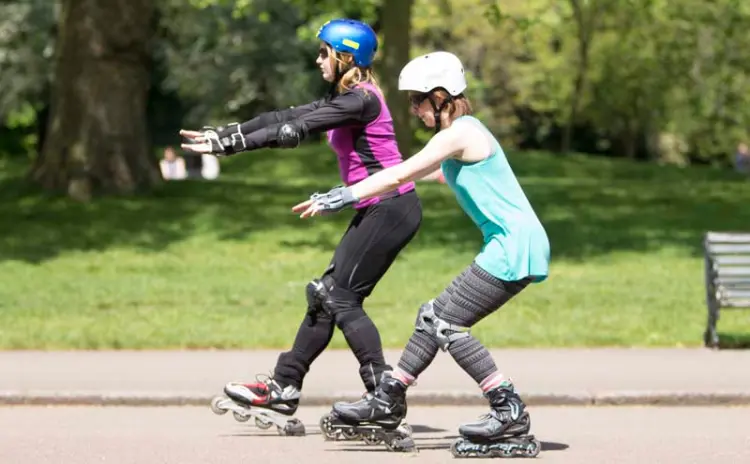
I looked up just in time to see another skater coming down the same almost-invisible slope.
They accelerated too.
But this time something different happened.
They used their heel brake with one skate in front of the other — and instead of spinning out of control, they slowed down smoothly.
I was fascinated.
In the next 25 minutes I figured out how to heel brake properly.
And once I could stop…
Everything changed.
Suddenly skating felt possible.
Controlled.
Even enjoyable.
That fall taught me something important:
Rollerblading isn’t just “put skates on and go.”
It’s a skill.
And the right technique changes everything.
That was the beginning of my second love affair with wheels — this time in a line.
And honestly?
That experience is a big part of why I teach the way I do now.
Because I know exactly what it feels like to think:
- “Why is this so hard?”
- “Why does everyone else make it look easy?”
- “Why do I feel out of control?”
If you’ve ever had a scary moment on skates — especially on a slope — you’re not alone.
Most skaters don’t need more courage.
They just need the right technique.
Have you ever had a moment like that on skates — where things suddenly felt out of control?
What did you learn from it?
If you’re worried starting to skate because you’re fearful of falling over and getting injured, this isn’t an unreasonable fear. Falls can and do happen and injuries unfortunately can be the result. But falls aren’t random. They always happen when you aren’t in control of your skates, and that’s usually always a technique gap.
If you’re ready to learn inline skating on purpose so you aren’t falling due to trial and error, our Beginner “Zero to Hero” online program is the step-by-step system that’s been used successfully by thousands of people worldwide. It even teaches you how to correctly analyse your own skating using your phone, so you’ll know if you’re on track or not quite there yet.
https://skatefresh.com/beginner-bundle/
There is a right way and a wrong way to learn to skate. Figuring it out on your own is not recommended, unless you like the surprise of random falls and slow, frustrating progress.